Ramana Maharshi
1879 — 1950 · Arunachala, India

The quiet
way inward.

A life of stillness. A single question that turns the mind toward its source: “Who am I?”

Bring a question
A tribute to Sri Ramana Maharshi
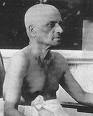
Archival black-and-white portrait of Sri Ramana Maharshi
Arunachala · Tamil Nadu
Your own Self-Realization is the greatest service you can render the world.
Sri Ramana Maharshi

The quiet enquiry

Bring one concern. Follow it gently, one question at a time.

Ramana Maharshi · A quiet enquiry

Bring what is here.

Choose one place to explore. Let each question unfold.

Private to this device · nothing is saved.

What would you like to bring?

Archival photograph · Sri Ramana Maharshi

Modern follow-up questions are prompts for reflection, not Ramana’s words. Dialogue excerpts are short quotations from recorded conversations in Talks with Sri Ramana Maharshi; the original “Who Am I?” question-and-answer text is also linked. Their English wording follows the published sources.

Or explore a specific question

These reviewed reflections connect everyday concerns with Ramana’s recorded teachings and their source.

A reflection to begin

Choose a question.

Recorded teaching

The source library will show where a teaching comes from, so you can read Ramana’s words in context.

A reflection for today

A modern connection is interpretation, not a claim that Ramana answered this exact situation.

A moment of inquiry

When ready, notice the thought or feeling that brought you here. Ask inwardly: to whom has it arisen?

Read the source

Choose a question to see its reference.

This first edition searches a small, reviewed library of reflections. Your search stays in this browser; it is not sent or saved. These reflections are not a substitute for practical, medical, or mental-health support.
His recorded words and modern reflections are kept distinct.Open “Who Am I?” from Sri Ramanasramam ↗

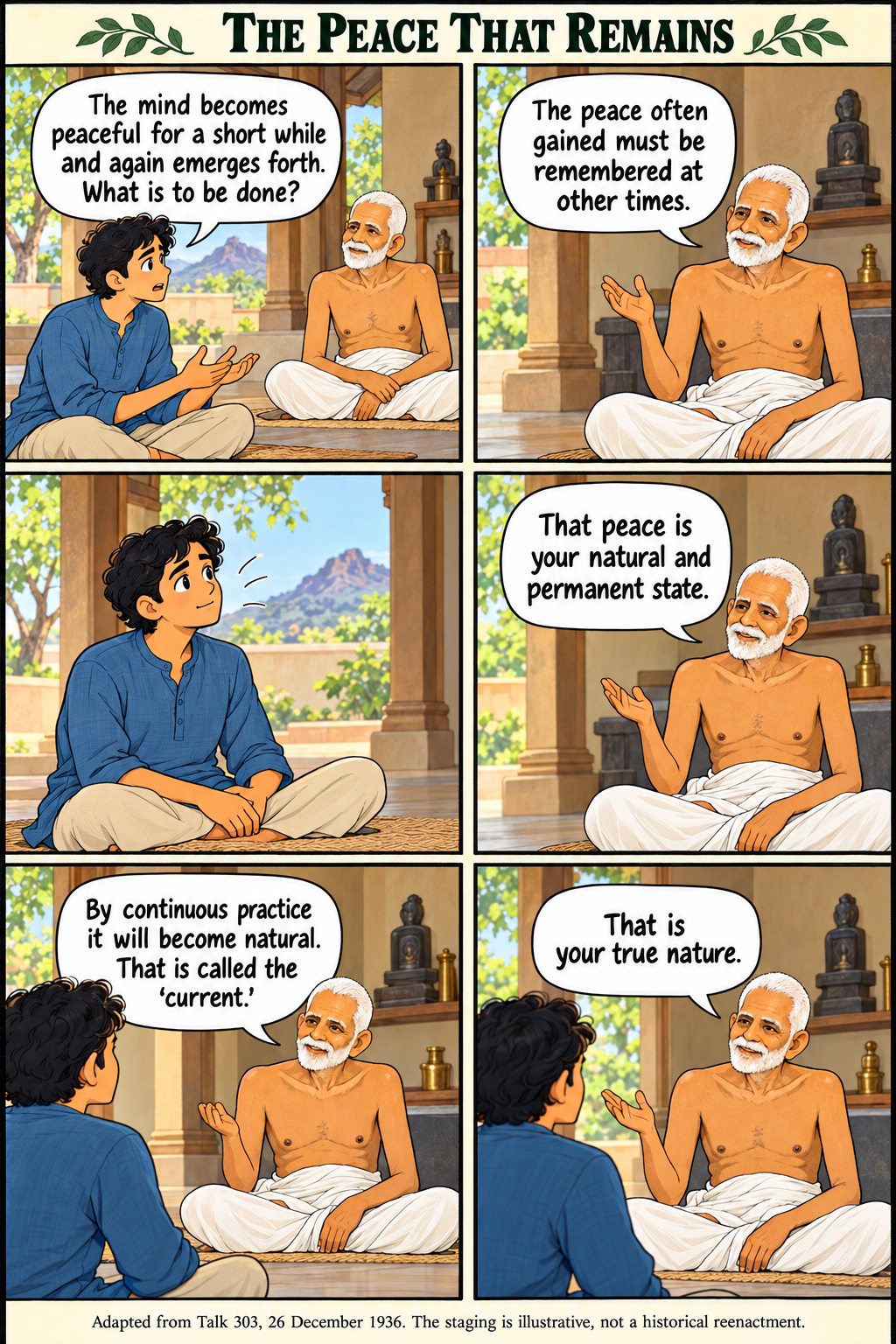
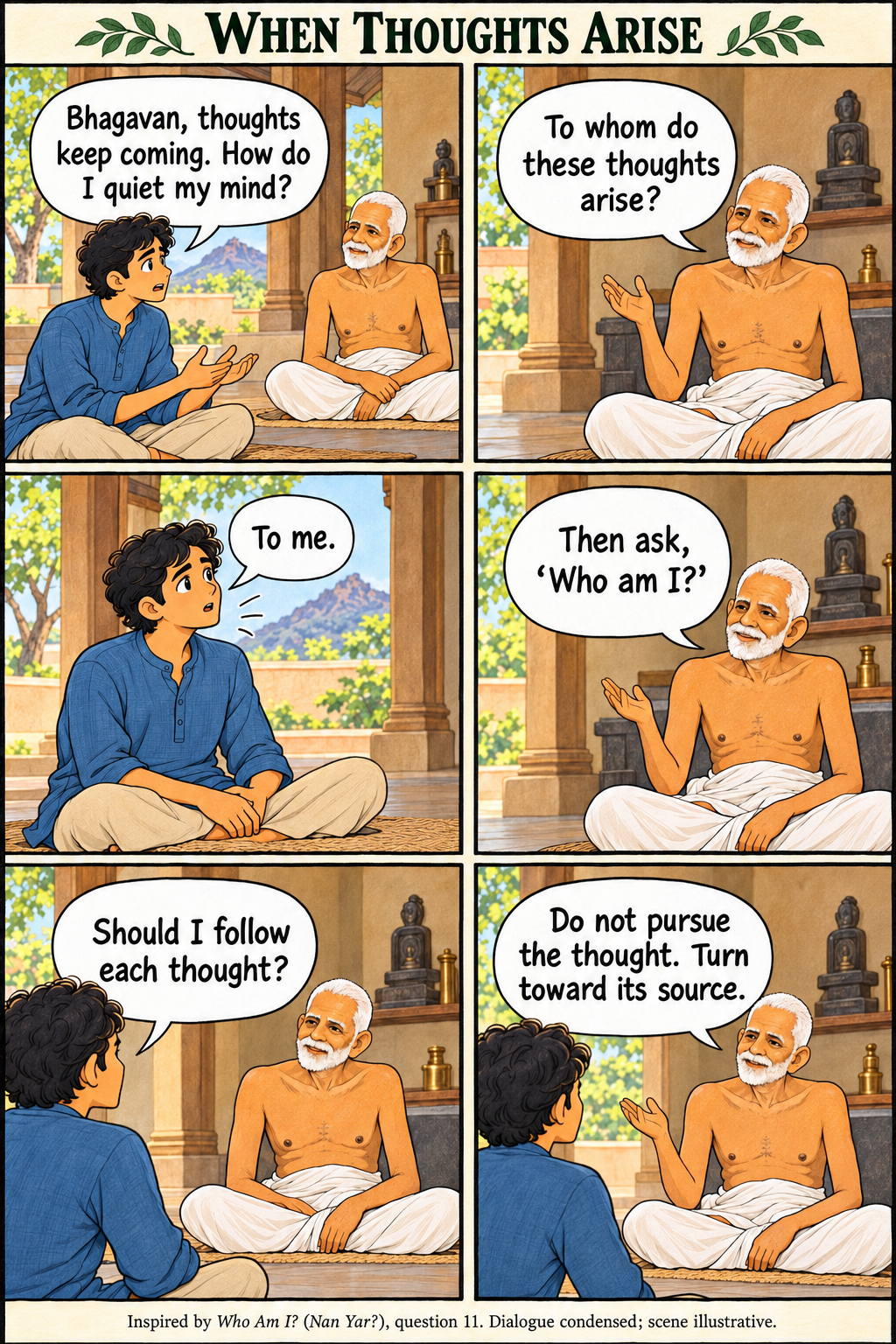
Stories to turn within.

Simple questions. Familiar images. A quiet invitation to discover yourself.

Swipe or scroll to explore

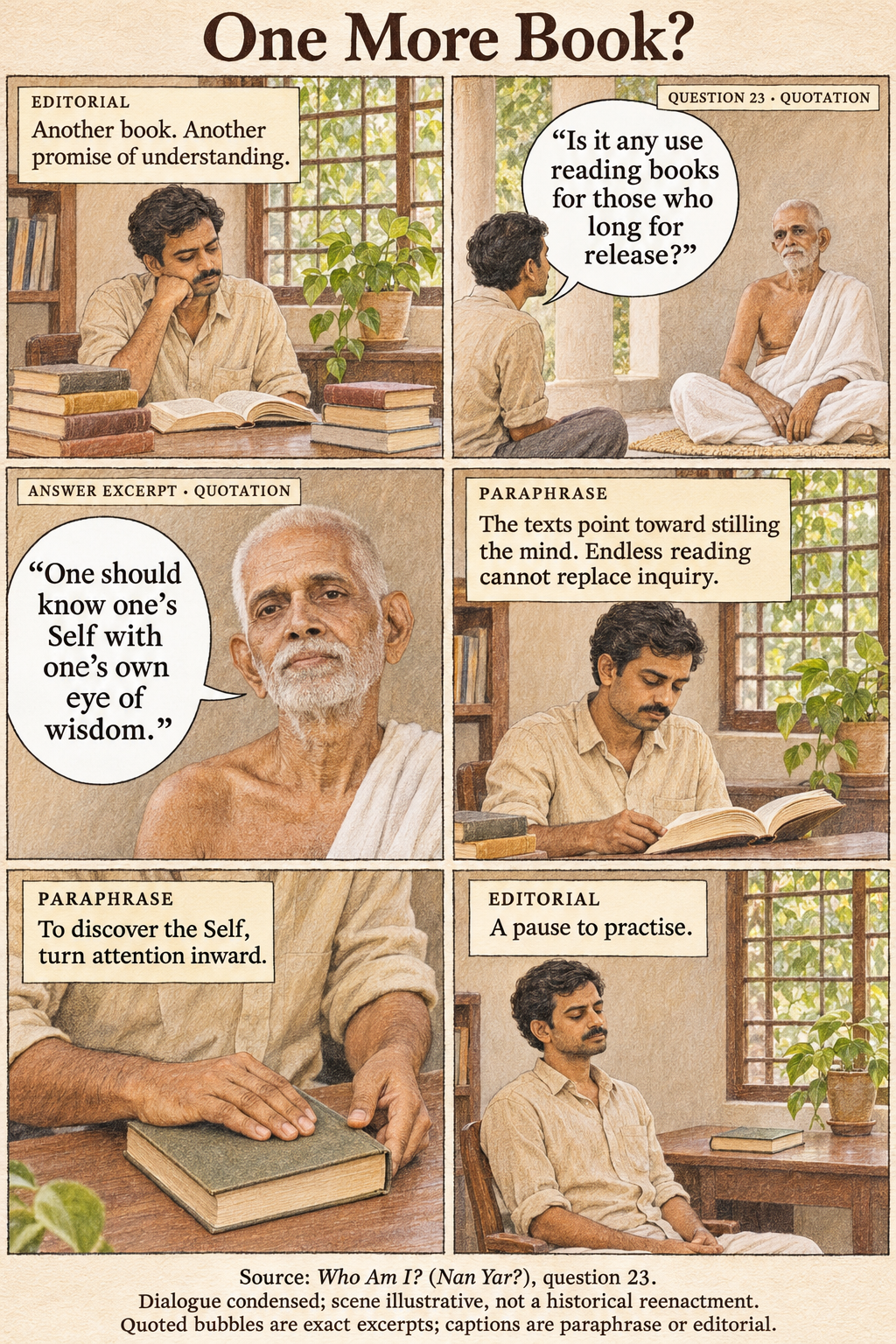
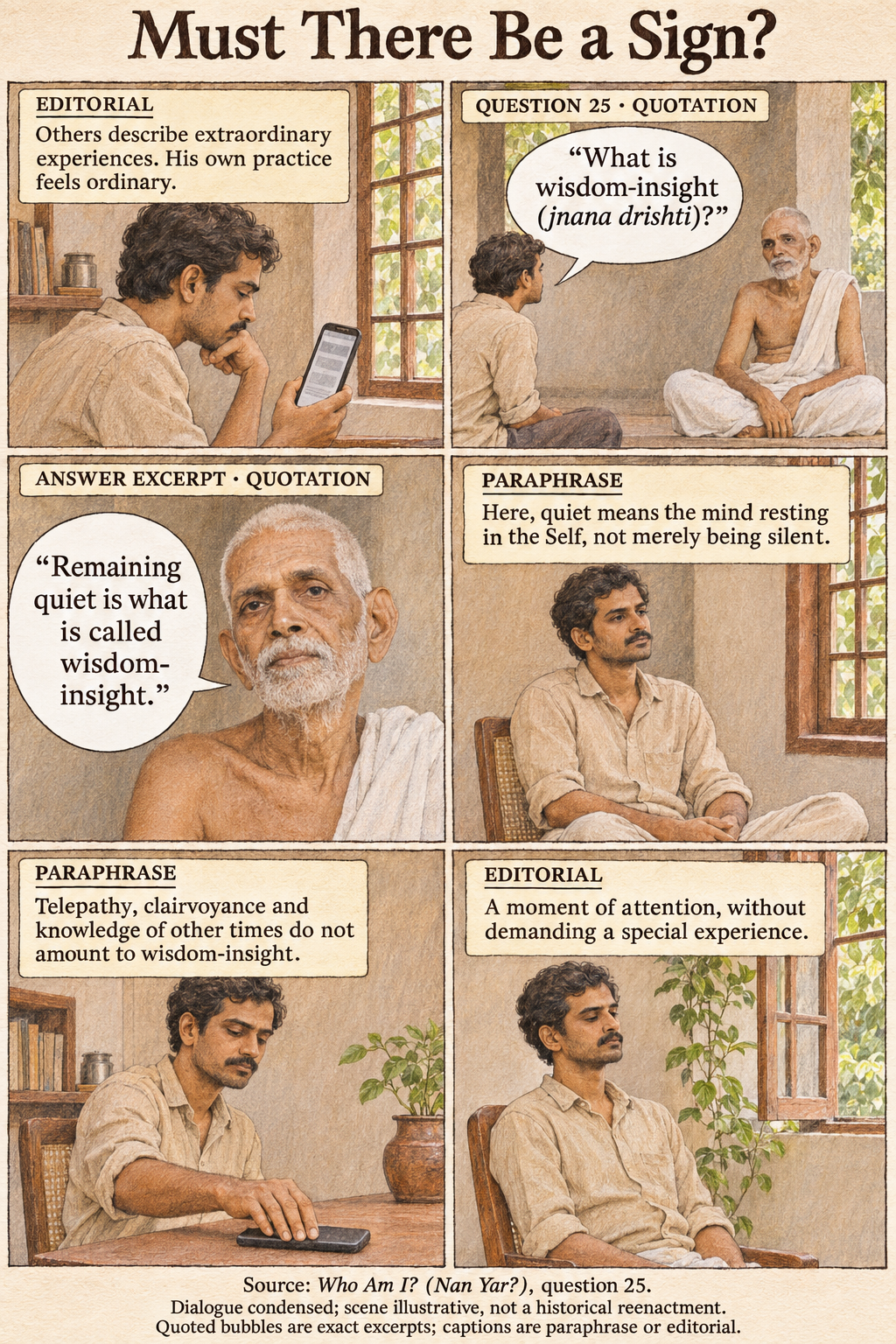
Six-panel colored-pencil comic: a seeker compares spiritual experiences, considers Ramana Maharshi’s answer to question 25 of Who Am I?, and pauses without demanding a special experience.Read the story
Wisdom · Extraordinary experiences

Must There Be a Sign?

A seeker wonders whether spiritual practice needs extraordinary experiences as proof. Ramana’s teaching distinguishes wisdom-insight from unusual powers.

Open the shareable story page

Adapted from Who Am I? (Nan Yar?), question 25. Quoted bubbles are exact excerpts; captions are paraphrase or editorial. Dialogue condensed; scene illustrative, not a historical reenactment. Read the published source.

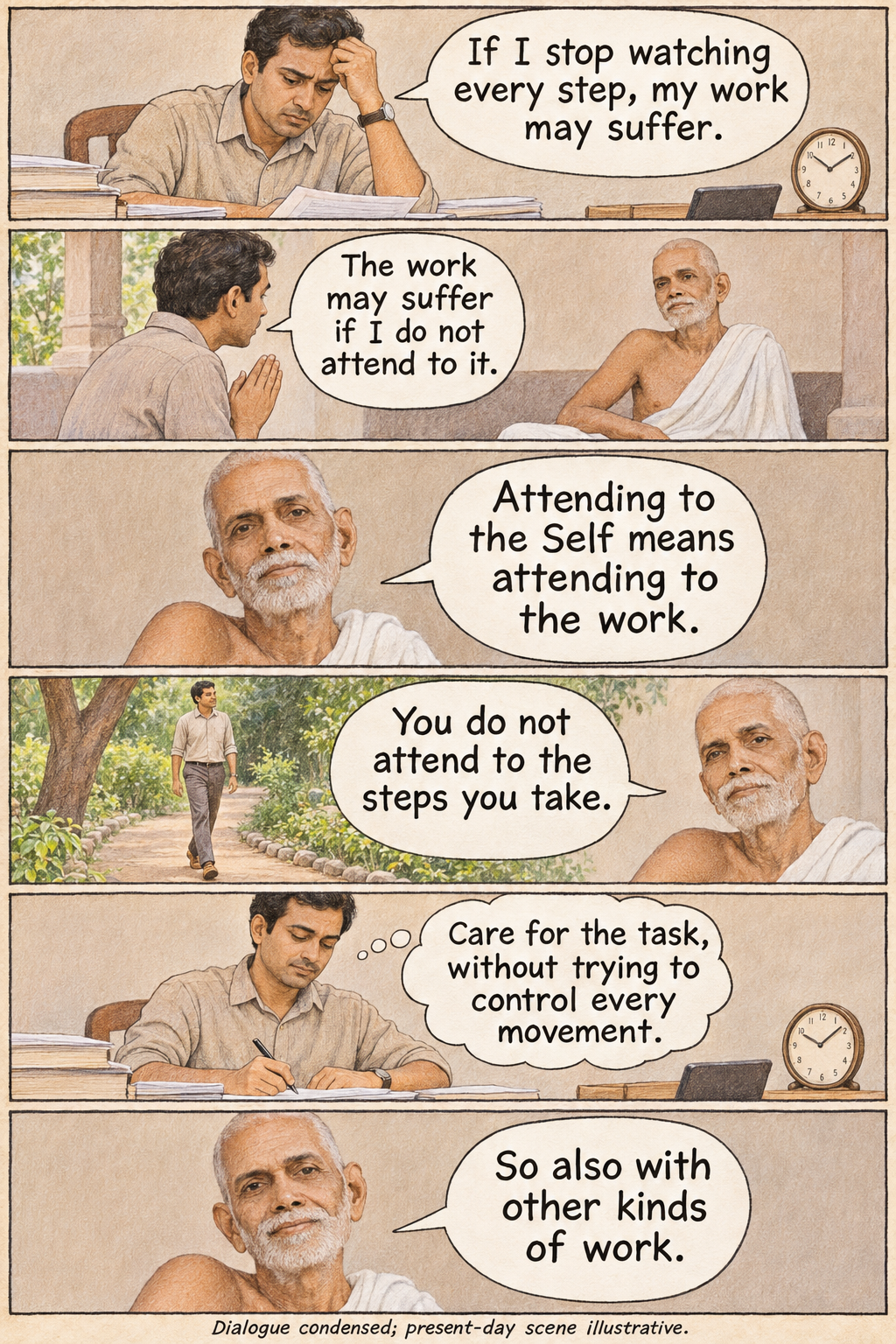
Six-panel illustrative comic about caring for work without trying to control every movementRead the story ↗
Work · Letting go

Care Without Control

A seeker wonders whether work will suffer without constant oversight. The conversation points toward acting carefully without carrying the burden of control.

Open the shareable story page ↗

An original illustrative dialogue inspired by Ramana Maharshi’s teaching. The wording and present-day scene are not a historical quotation or reenactment.

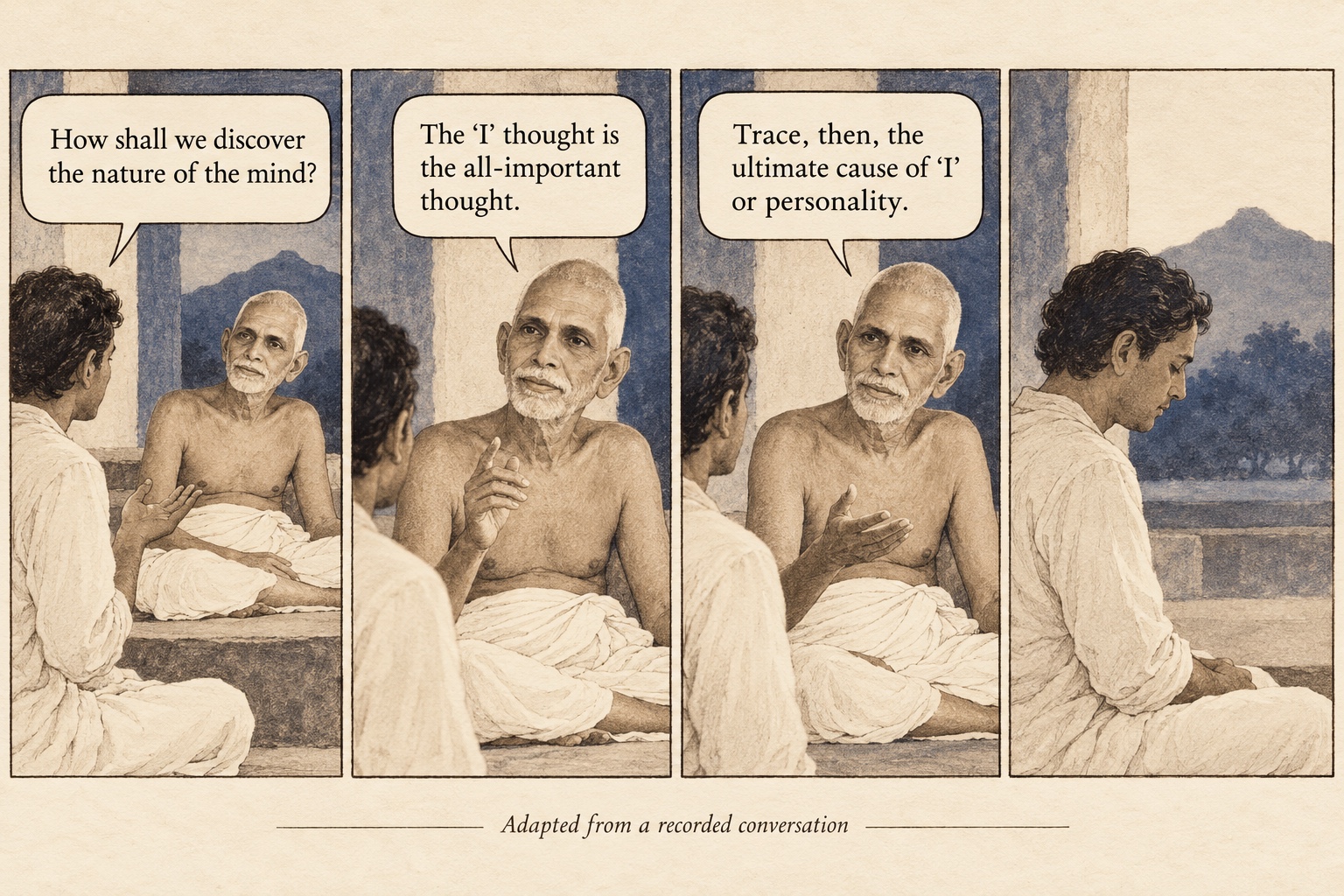
Four-panel comic adaptation of a conversation with Ramana Maharshi about discovering the nature of the mind and tracing the ‘I’ thoughtRead the story ↗
Mind · Self-enquiry

The ‘I’ Thought

A seeker asks how to discover the nature of the mind. Ramana points attention to the “I” thought.

Adapted from Talk 26, Talks with Sri Ramana Maharshi, 4 February 1935. Dialogue condensed; final panel illustrative.

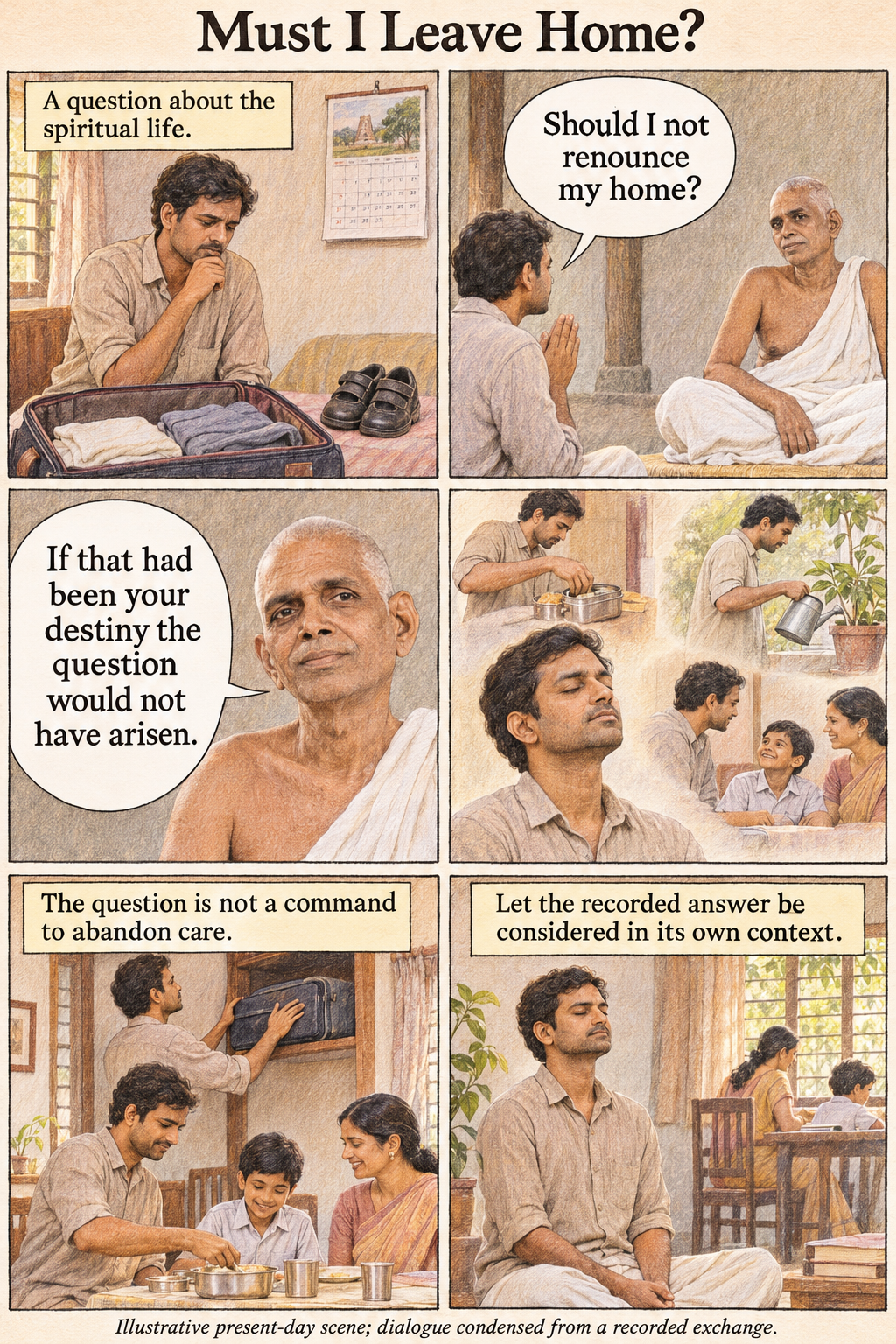
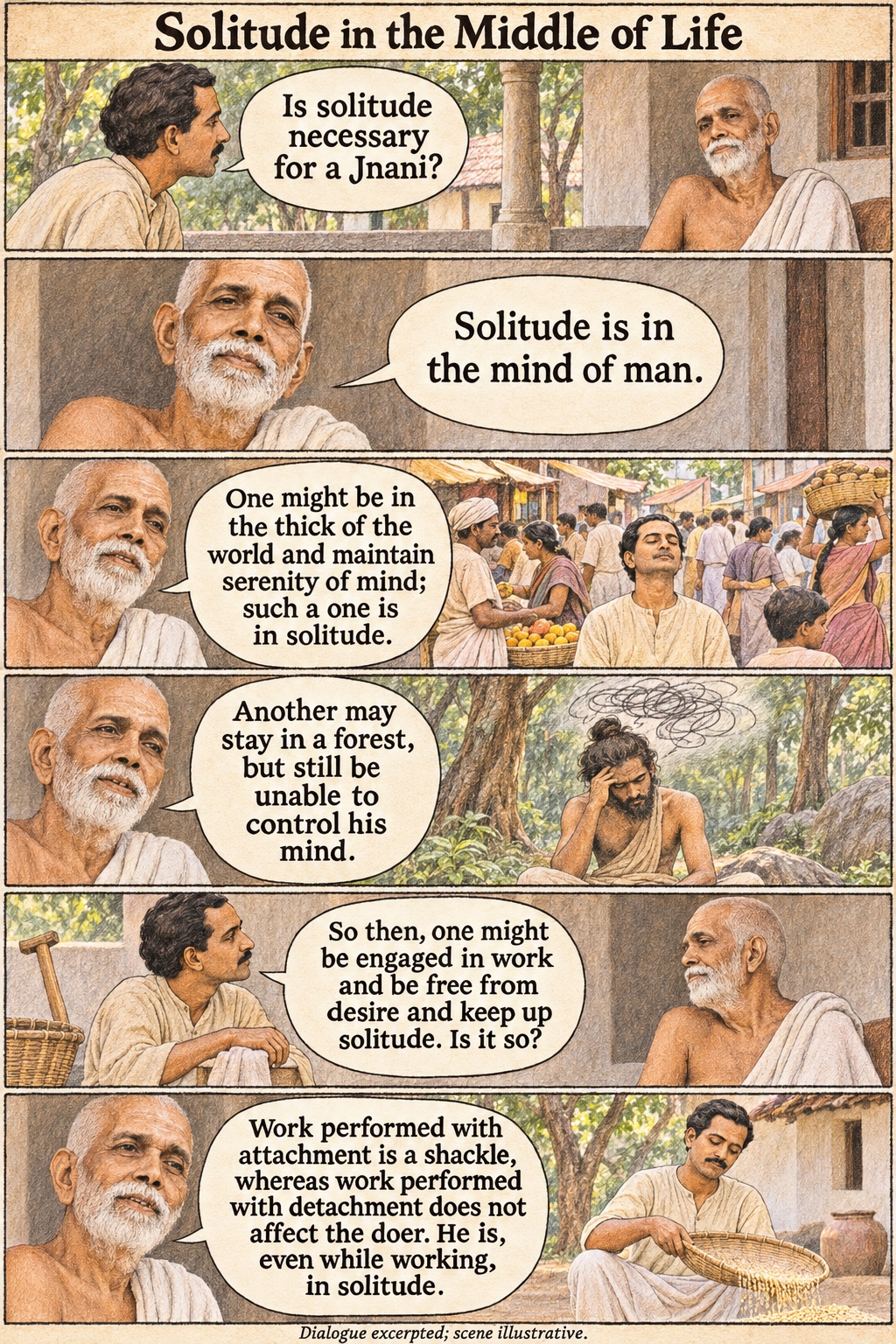
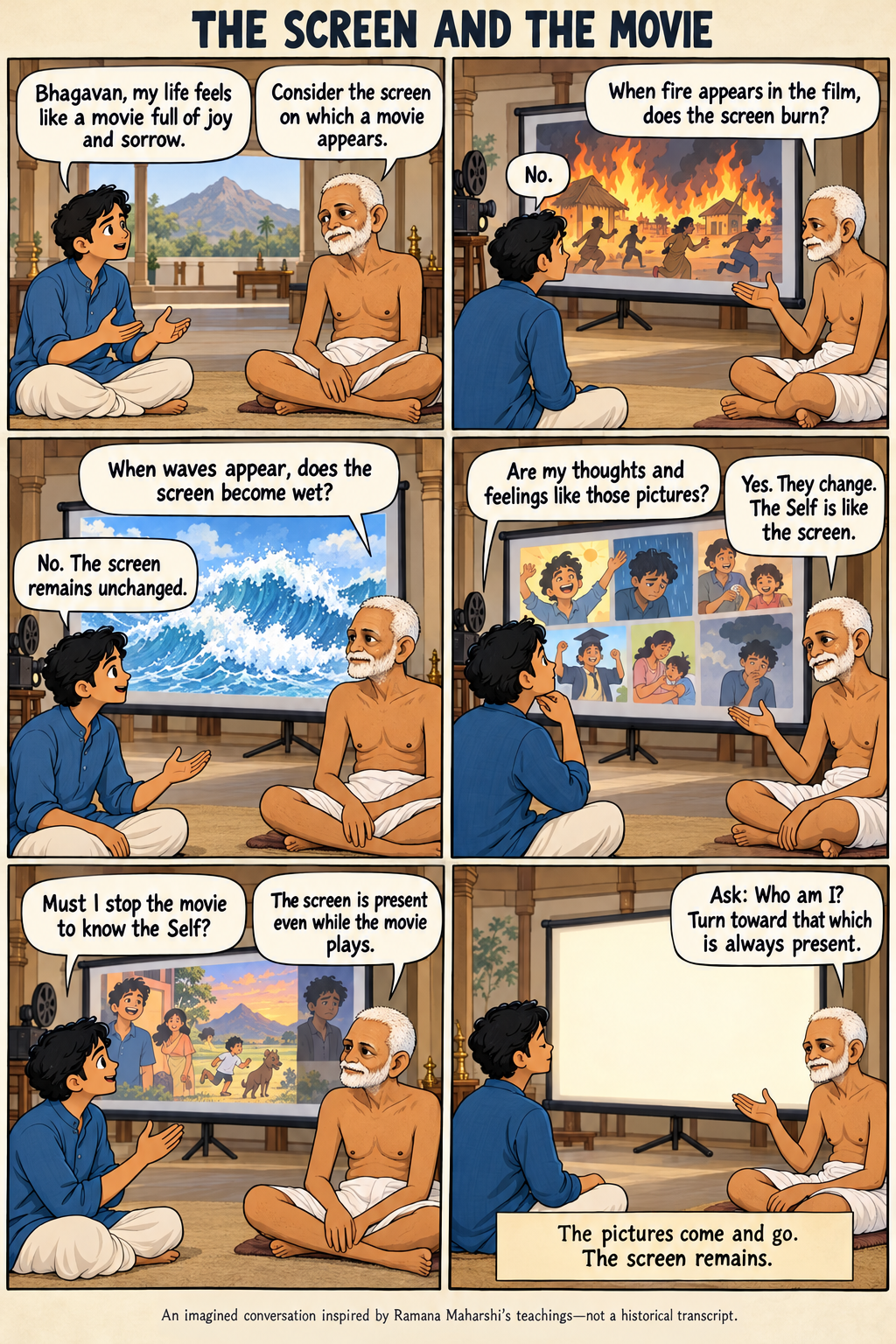
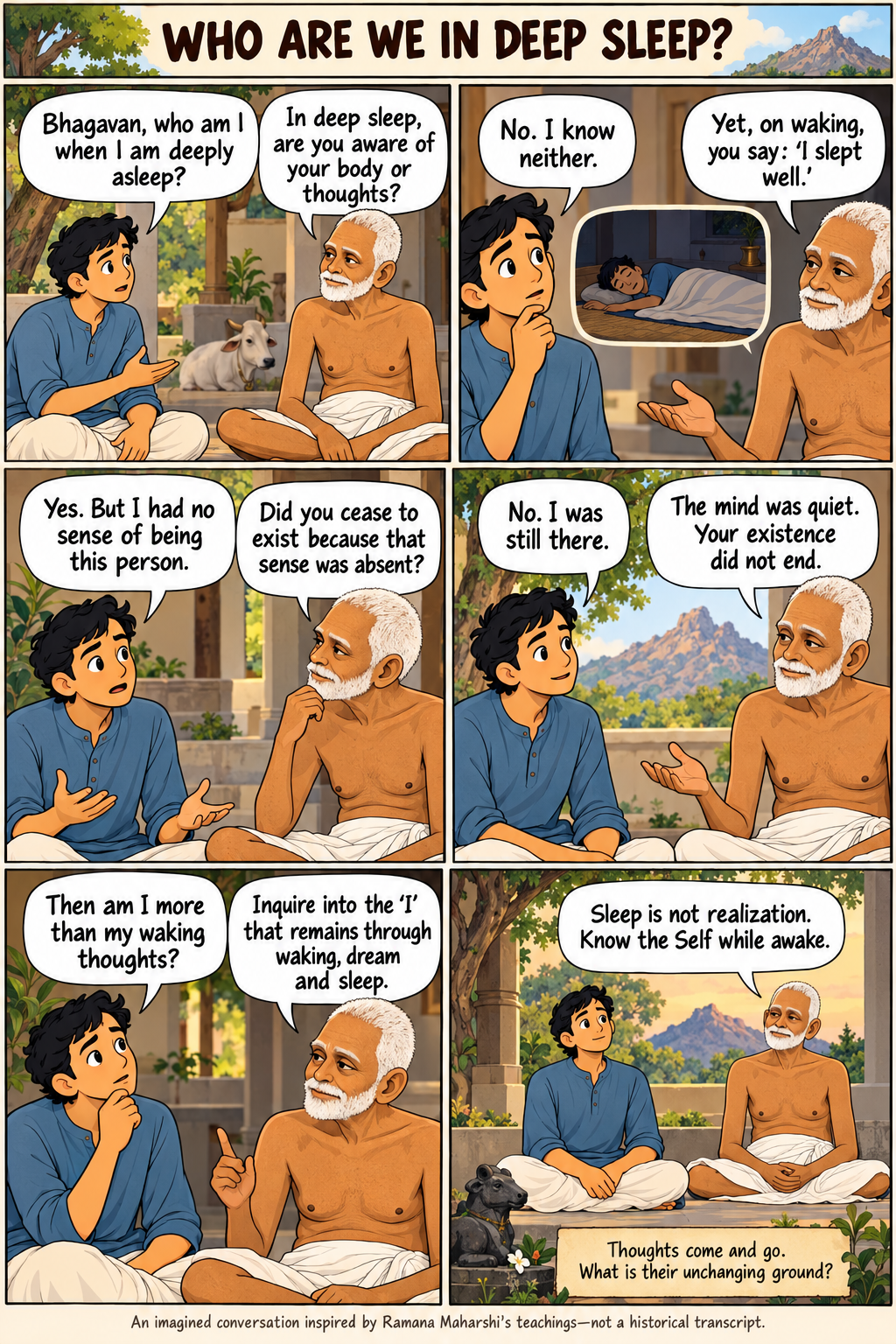
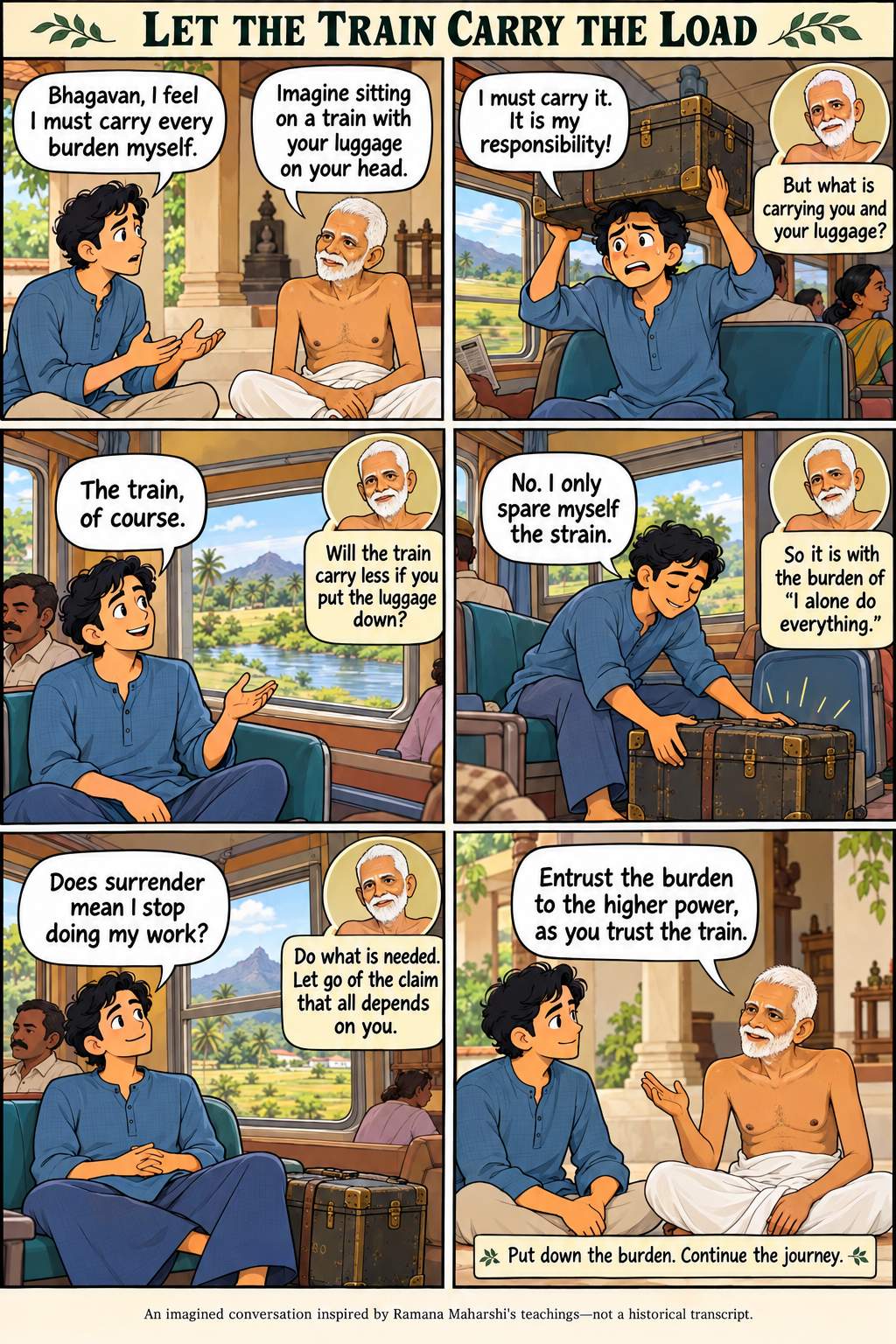
These illustrated stories offer reflections on Ramana Maharshi’s teaching. Where a story adapts a recorded conversation, that is stated with the comic; imagined scenes are illustrative rather than historical reenactments.

Turn within.

Not a philosophy to collect, but an invitation to look directly at the one who asks.

“The mind is only a bundle of thoughts. The thoughts have their root in the ‘I’-thought.”
On the mind
“There is no mystery greater than this: being Reality ourselves, we seek to gain Reality.”
On the Self
“Happiness is your nature. It is not wrong to desire it. What is wrong is seeking it outside.”
On happiness
Ramana Maharshi seated quietly on a rock

Who am I?

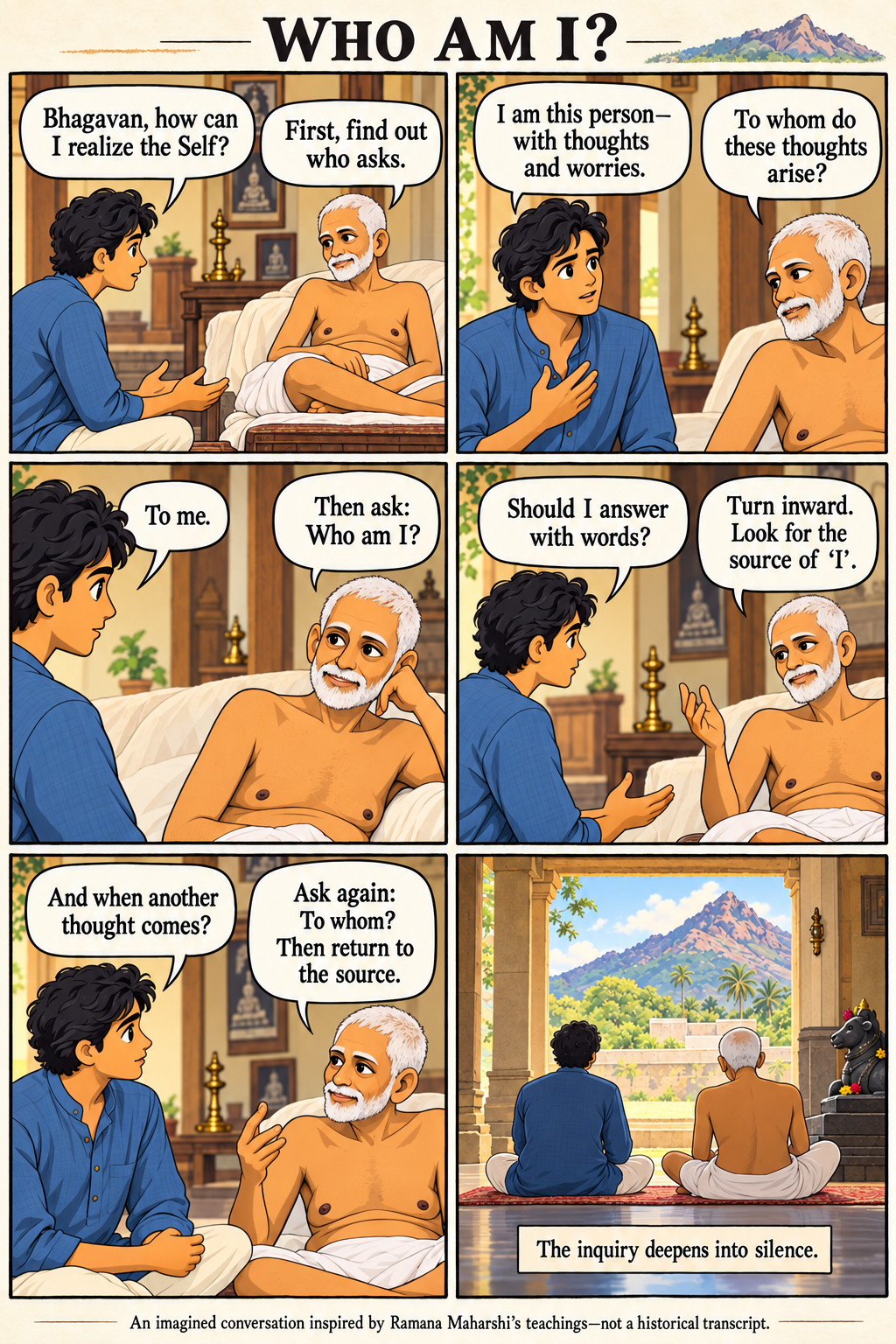
Ramana Maharshi pointed to self-enquiry: when a thought arises, ask who is thinking it. Follow the sense of “I” inward—not as an idea to answer, but as a way of attending to its source.

For him, silence was not an absence. It was the ground from which thought, identity, and experience appear.

Stay with the question. Let it lead you back.

Stillness
made visible.

Born Venkataraman Iyer in 1879, he was drawn as a young man to Arunachala, the sacred hill at Tiruvannamalai. He remained there for the rest of his life, and seekers from many places came to sit near him.

He taught through brief answers, ordinary acts, and long stretches of silence. His message asked no one to adopt a new identity: look for the one who feels separate, and see what remains.

1879Born in Tamil Nadu
1896Journey to Arunachala
1950Entered mahasamadhi

Other voices
on self-enquiry.

Three teachers who offer related ways of investigating the Self. Different voices, with Ramana’s enquiry as our starting point.

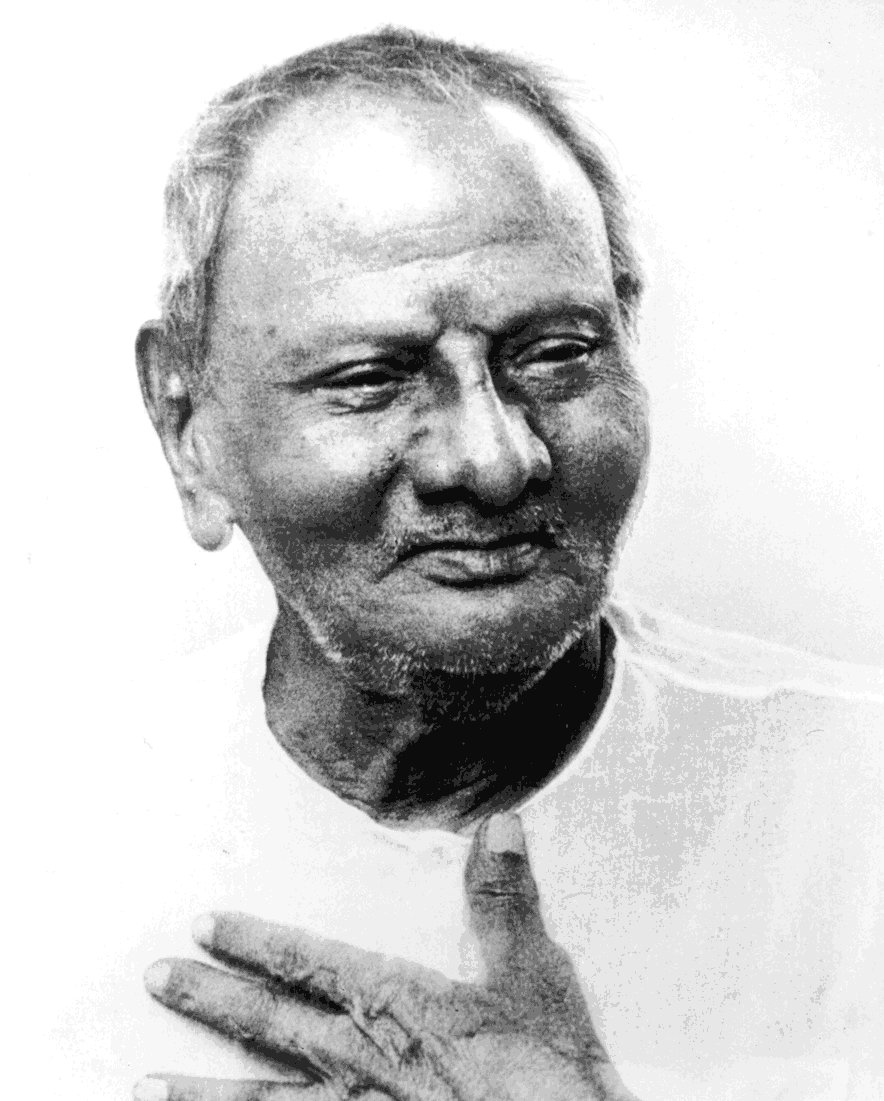
Archival photograph of Nisargadatta Maharaj

1897–1981 · Mumbai

Nisargadatta Maharaj

Begin with the sense “I am.”

His dialogues invite us to look beyond the body, thoughts and personal history, beginning with the simple sense of being.

Explore the teaching ↗
Archival photograph of Atmananda Krishna Menon

1883–1959 · Kerala

Atmananda Krishna Menon

Notice the knowing in every experience.

His direct approach explores seeing, thinking and feeling to investigate the awareness in which experience is known.

Explore the teaching ↗
Archival photograph of H. W. L. Poonja · Papaji

1910–1997 · Lucknow

H. W. L. Poonja · Papaji

Recognise what is present now.

A devotee of Ramana, Papaji used direct conversations to turn seekers back towards the source of the mind.

Explore the teaching ↗

These teachers share a concern with non-dual understanding, but their methods, language and traditions are distinct. The connections described here are editorial comparisons, not claims that their teachings are identical. Each profile includes sources and a place to begin reading.

“The realization of the Self is the greatest help that can be rendered to humanity.”
Ramana Maharshi

Open image ↗